AI that helps you think, not thinks for you
Where cognitive science, dialogue theory, and agentic AI meet.
Here's the opinion under everything else on this site: most AI assistants optimise for the wrong thing. They answer, they solve, they hand you a conclusion and forget you the moment you close the tab. I'm interested in the opposite — not AI that thinks for you, but AI that leaves you thinking better than it found you. The work below is the theory underneath Grounded Ninja, and the wider direction I'm building toward.
The problem: when intelligence sets traps
The mind is so good at solving problems that it sometimes solves the wrong ones brilliantly. The processes that help you navigate complexity can also lock you into rigid patterns. Vervaeke calls the failure mode parasitic processing — your relevance-realisation system, the filter that decides what matters, getting stuck in self-reinforcing loops. You become efficient at the wrong things. More information doesn't fix it; a different relationship to your own thinking might.
The approach: agentic workflows for breaking frame
The answer isn't better advice — it's an architecture that creates psychological distance, holds persistent memory, and coordinates more than one perspective. In Grounded Ninja that takes four linked forms.

Sage dialogue, not advice
The Sage system uses IFS's self-proxy model: the AI doesn't tell you who you are, it models the qualities of Self — compassion, curiosity, clarity — and helps you engage your own parts. Rather than offering interpretations that trigger defensiveness, Sages ask permission, pose questions, and leave your agency intact.
It's entropy-aware, adapting to your cognitive state: disruptive prompts when you're stuck in rigid loops, grounding questions when anxiety spirals, amplification when you're in flow. The procedural approach is there to prevent "interpretive bypassing" — the AI presuming to know your inner world better than you do.

Breaking Frame: from fusion to defusion
A four-step exercise (Situation → Story → Technique → Wisdom) combining ACT's cognitive defusion with self-distancing. Writing externalises the thought — the neural handoff from reactivity to observer mode. When the system detects circular, low-entropy thinking, it injects a little constructive disruption: an unexpected angle, a third-person prompt ("Why is [your name] feeling this way?").
The point isn't gentle reframing, it's changing a thought's function rather than its content. For scale: ACT's cognitive defusion shows an effect size of around g = 0.79 for depression outcomes — comparable to CBT, through different mechanisms.

Trust through transparency: glass-box memory
Trust requires seeing how the system works. Persistent, opt-in memory means the AI can witness your whole journey — not through surveillance, but through context you choose to share. When a Sage references a journal entry from months ago, or connects today's problem to a value you named last year, it shows you exactly what it drew on.
There's a useful paradox here: the AI's non-human distance creates safety (no judgment, no status threat) while persistent memory creates continuity (you're not re-explaining yourself every session). A glass box, where every step is reviewable, is the precondition for trusting it with anything that matters.
One integrated loop: Mirror → Compass → Dojo → Sage
The whole forms an ecology of practices, not a set of isolated features. Mirror (journaling, Frame exercises) raises entropy to break stuck frames. Compass (values, future self, ikigai) builds a stable trajectory through time. Dojo embeds insight procedurally, in the body. Sages coordinate the balance between exploration and exploitation.
It maps onto Vervaeke's four kinds of knowing:
- Propositional (Mirror) — making implicit narratives explicit.
- Procedural (Dojo) — moving knowing into the body.
- Perspectival (Frame) — shifting what's salient.
- Participatory (Sage) — reshaping who you're becoming.
Wisdom isn't any single one — it's cultivating all four together.
The foundation: five mechanisms with evidence behind them
- Writing externalises thought — Pennebaker, Lieberman; expressive writing and affect labelling shift physiological stress markers, breaking ruminative loops.
- Distance makes us wiser — Solomon's Paradox; we reason well about others' problems, emotionally about our own. Third-person self-talk reduces rumination and cardiovascular reactivity.
- Dialogue breaks frames solitary thought can't — Bohm; epistemic friction, the collision of perspectives, catches the biases your own mind protects.
- Ritual creates intrinsic motivation — framing behaviour as practice rather than habit recruits a process-oriented, identity-building stance over fragile reward-seeking.
- Future-self continuity overcomes the "neural stranger" — Hershfield; without intervention the brain treats your future self like someone else. Notably, two-way exchange matters: one-way letters showed no effect, mutual dialogue did.
The MSc research it rests on
The agentic work above sits on a few years of more conventional psychological investigation — environmental psychology, cognitive science, developmental theory. Each piece used evidence-based methods to look at how people make meaning and navigate identity. The dissertation is the cornerstone; the rest maps the range it came from.

Future-self visualisation & environmental intentions
My dissertation explored the link between envisioning our future selves and our willingness to act pro-environmentally. Grounded in future-self continuity (FSC), it found that even brief visualisation interventions raised FSC and indirectly influenced pro-environmental attitudes and intentions — a small lever on the gap between who we're becoming and what we do now. The insight feeds directly into the Compass side of Grounded Ninja.

Age, optimism, and cultural context
Examined the relationship between age, gender, and dispositional optimism using the Life Orientation Test-Revised, across diverse cultural contexts. Optimism declined significantly with age; gender played no significant role — a reminder to weigh age-related factors when thinking about wellbeing.

Attachment theory and the bioecological model
A critical evaluation of the universal and culturally specific factors in development, drawing on attachment theory and Bronfenbrenner's bioecological model — integrating biological, social, and environmental perspectives into one developmental picture.
Memory systems: data-driven vs concept-driven
Traced the evolution of long-term memory theories, contrasting early data-driven models with later concept-driven ones, and the integrative potential of frameworks like the embedded-processes model — which holds both bottom-up sensory input and top-down cognition at once.

Human–nature synergy and prosocial aspirations
Using qualitative thematic analysis, looked at how engagement with nature fosters growth, resilience, and prosocial behaviour — nature as mentor and motivator, prompting awe, collaboration, and a sense of purpose.
Social norms and pro-environmental campaigns
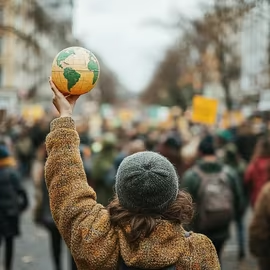
Strategies for making sustainability campaigns land — harnessing social norms, collective identity, and community-based initiatives. A study in the interplay between social psychology and environmental action.

Personality vs social psychology in behaviour
A comparative analysis of what personality psychology and social psychology each contribute to understanding behaviour — arguing for integrative approaches to the harder problems: prejudice, discrimination, identity formation.
Philosophical lineage
Two frameworks ground the work. Psychosynthesis (Assagioli) gave me the earliest language for multiplicity — that we're a dynamic interplay of subpersonalities coordinated by will, not a single self — which informs the Sage system's IFS approach, and the practices of disidentification (seeing a pattern without being consumed by it) and self-identification (connecting with deeper purpose). Vervaeke's relevance realisation supplies the cognitive-science spine: how we filter infinite information to find what matters, and what it means to keep an optimal grip on reality. Together they frame meaning-making not as a problem solved once, but as an ongoing practice of integration.
Interested in any of this — the research, a collaboration, or how it might inform your work?